 Debridgefinance
 transfer fees in DLN quotes and final settlement
Debridgefinance transfer fees combine protocol charges, solver costs and source-chain gas for a deBridge Liquidity Network (DLN) cross-chain order. The quote can itemize these costs, while optional affiliate fees, intermediary swaps and hook execution can change the total. Final accounting compares the actual source debit with the destination amount delivered.
Updated on
Contents
The short version: A DLN quote can add solver operating expenses to the source amount, increasing the required allowance when the input is an ERC-20 token.
Protocol charges, solver costs and source-chain gas
A DLN transfer combines source-chain protocol charges and transaction gas with solver margin and execution expenses across both chains. The flat charge compensates validators for processing the eventual unlock message. A variable fee comes from the order's input token. The source transaction records the input debit and network gas; destination fulfillment records delivery. Some charges use the transferred token, while others use native currency. A native-currency wallet debit can include both the protocol's flat fee and transaction gas.
Solvers provide destination liquidity and later claim the locked source tokens. Their operating expenses cover fulfillment, sending the unlock message and claiming the source funds. Market and reverse-market quotes include a margin giving a solver an economic reason to fill the order. That margin belongs to the quoted spread, the difference between input and output values. It is distinct from the source gas the wallet pays to create the order.
Intermediary swaps add price exposure when a route requires token conversions. A pre-order swap converts non-reserve source tokens into a reserve asset before order creation. A pre-fill swap buys the requested destination token with reserve assets before fulfillment. Slippage during those conversions, the difference between expected and executed swap prices, is distinct from the protocol percentage.
Token units and the percentage fee base
DLN's listed variable protocol fee is 4 basis points, equivalent to 0.04% of the order's input token amount. Integrations should query the quote's protocol-fee detail or
DlnSource.percentFeeBps()
, because the applicable rate is a protocol parameter.
The flat protocol charge uses the source chain's native currency, and
DlnSource.globalFixedNativeFee()
exposes the applicable amount. Its fixed amount applies independently of transfer size at the same chain setting, making it proportionally larger for smaller transfers.
The application programming interface (API) represents token amounts in each token's smallest units. Token decimals convert those integers into displayed balances.
Response cost labels distinguish
DlnProtocolFee
,
EstimatedOperatingExpenses
and
TakerMargin
within
estimation.costsDetails
. The returned input and output amounts already reflect those components under the requested pricing configuration. Adding every cost line to an adjusted input would count some charges twice. Keep native-currency charges separate from token-denominated deductions. On EVM source chains, estimatedTransactionFee.total excludes the flat fee. On Solana, that total includes the fixed fee and applicable account costs, so do not add those components again.
How does prepending operating expenses change the source amount?
Enabling
prependOperatingExpenses
adds estimated solver operating expenses to the input amount the DLN quote returns.
Consider a hypothetical USDC quote from Arbitrum to Polygon with a requested input of 746 USDC and estimated operating expenses of 0.036 USDC. The only change between the requests is whether
prependOperatingExpenses
is enabled. Both requests retain the same assumed market conditions and expense estimate.
With the setting enabled, the quoted source-token total is 746.036 USDC: 746 plus 0.036. At six decimals, that total equals 746,036,000 smallest units. An ERC-20 allowance covering only 746 USDC would leave the extra operating expense uncovered.
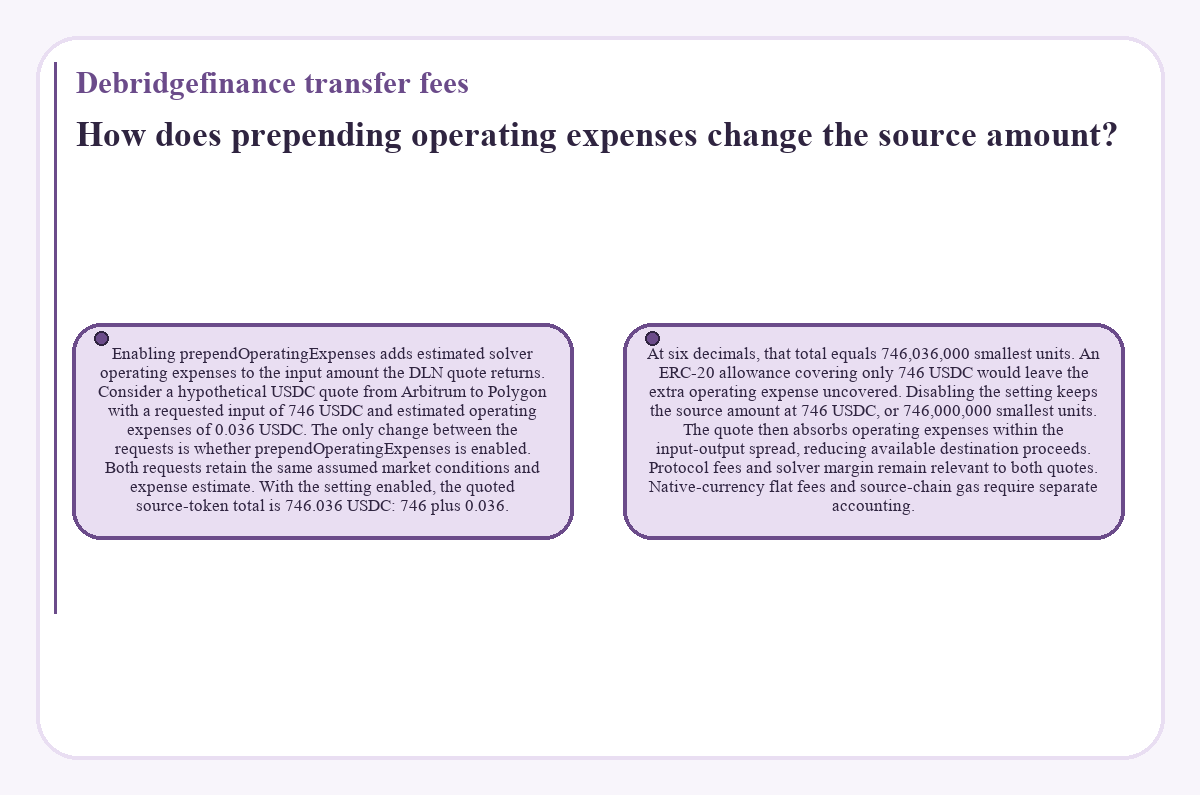
Disabling the setting keeps the source amount at 746 USDC, or 746,000,000 smallest units. The quote then absorbs operating expenses within the input-output spread, reducing available destination proceeds. Protocol fees and solver margin remain relevant to both quotes. Native-currency flat fees and source-chain gas require separate accounting.
Fresh quotes, approvals and submission
Quote freshness affects solver economics and, for ERC-20 inputs, the allowance needed to create a DLN order. The
create-tx
response supplies expected output and cost details, plus transaction data when the required authority and recipient addresses are provided. An unsigned response does not create an on-chain order. A successful source-chain transaction creates the order and locks its input. Prices and gas estimates can move while wallet confirmation waits. Refresh an unsubmitted quote after about 30 seconds to update its market and gas estimates.
ERC-20 approval authorizes a spender to transfer tokens; placing the order is a separate operation. With prepended expenses,
response.estimation.srcChainTokenIn.amount
supplies the total token amount requiring approval. A refreshed estimate may raise that amount, while an on-chain approval can consume gas separately from order creation. An existing sufficient allowance avoids another approval transaction, while a supported signed permit can authorize the transfer within the submission flow.
The refresh interval applies before submission. It does not establish an expiry deadline for an order already created on-chain.
Destination delivery and source-chain settlement
Destination fulfillment records the output a solver supplied, while later source-chain unlocking settles the solver's reimbursement. The standard order fixes a requested destination token and amount. A solver accepting those terms must supply that output. An unfilled order remains open when no solver accepts its economics; a quoted rate alone does not establish completed delivery.
deExplorer locates orders through an order ID, transaction hash or wallet address. Its fulfillment details support reconciliation of the requested amount with destination delivery. Source-chain unlocking then releases the locked funds to the winning solver. Count wallet gas actually paid separately from solver expenses already incorporated into the quote. This keeps the same destination expense from entering the total twice.
Affiliate fees and destination hook rewards
Optional affiliate fees and hook rewards add costs only when an integration or order includes those settings. An affiliate fee allocates a percentage of the input token to a configured recipient. Cross-chain DLN affiliate fees become available when the solver claims the source funds. EVM payout is normally automatic. Solana fees and EVM fees owed to a recipient contract needing more than 2300 gas require manual withdrawal. Confirming the initial source transaction does not establish that payout. A referral code is required to enable affiliate fees. The request sets the percentage and recipient through
affiliateFeePercent
and
affiliateFeeRecipient
.
deBridge Hooks attach destination actions to orders. On Ethereum Virtual Machine (EVM) chains, an atomic hook runs during fulfillment; the order's spread can cover its execution cost. A non-atomic hook may run later and can specify an execution reward. If fulfillment precedes non-atomic hook execution, the output waits in an intermediary contract for execution or hook cancellation. When the hook runs, the contract deducts the configured reward from the output before forwarding the remainder to the hook. The output amount and the amount reaching the attached action can therefore differ.
Which fees return when a DLN order is cancelled?
Cancelling an unfulfilled DLN order returns its locked source-chain funds, including protocol and affiliate fees. Source-chain gas already spent creating or approving the order sits outside that refundable contract balance.
Manual cancellation requires the designated destination-chain authority. The cancellation payload identifies the permitted sender, chain and source-chain beneficiary. The refund completes when the cancellation message is claimed on the source chain. Its native-currency transaction value covers a messaging fee and prepaid source-chain claiming costs. Destination-chain transaction gas is additional. These new cancellation expenses are separate from the original order-creation fees returned with the locked funds.
Approved integrations can enable subsidized automatic cancellation for market orders associated with a referral code. That service excludes limit orders. Its destination authority is deBridge-controlled, while
srcAllowedCancelBeneficiary
specifies the user-controlled source-chain refund address. If the beneficiary is omitted and a source order authority was supplied, that authority becomes the fallback.
Debridgefinance transfer fees: DLN API Itemizes Costs
- Destination delivery and source-chain settlement
- Affiliate fees and destination hook rewards
- Which fees return when a DLN order is cancelled?
A source-side pre-order swap changes what cancellation returns. The refund uses the asset actually locked, which can be a reserve asset instead of the original token.
estimation.srcChainTokenOut
identifies the refund asset and amount when present. Without a pre-order swap,
srcChainTokenIn
identifies the asset to return. The refund does not reverse an earlier token conversion.
Cost boundaries for same-chain swaps and dePort
Same-chain swaps and dePort use different execution paths, so a DLN cross-chain fee formula cannot describe every deBridge transfer. Same-chain routing compares aggregators and applies its own swap transaction and slippage controls. dePort locks original tokens and mints backed representations on another chain. Its transfer specification includes a percentage deduction and a fixed fee in native currency, plus applicable network costs. The DLN variable fee and solver spread should not be copied onto a dePort estimate.
Like-for-like transfer totals
Comparable transfer quotes need matching source and destination networks, token deployments, recipient requirements and pricing times. A larger destination output may reflect a larger source debit when expenses are prepended. Native-currency charges need their own line even when the transferred asset is a token. If input and output assets differ, raw token-count subtraction cannot measure monetary cost. Any conversion into a common currency needs a consistent price basis.
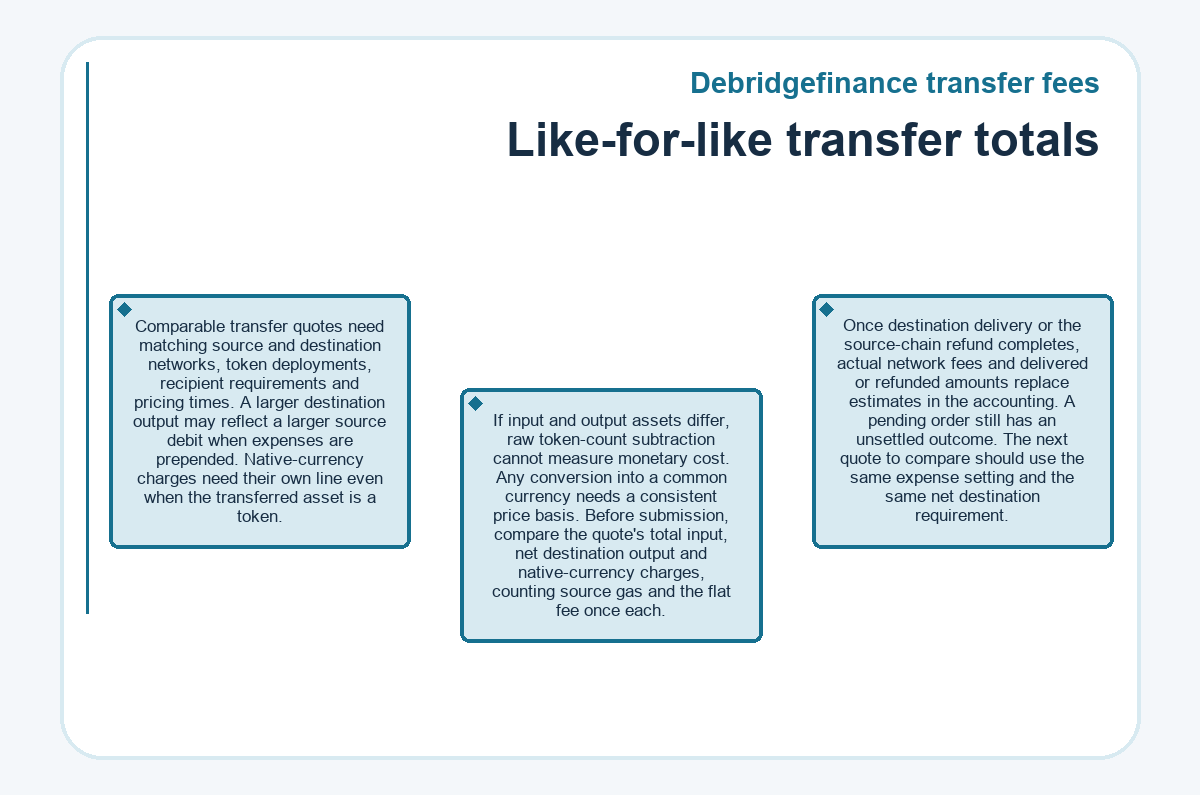
Before submission, compare the quote's total input, net destination output and native-currency charges, counting source gas and the flat fee once each. Once destination delivery or the source-chain refund completes, actual network fees and delivered or refunded amounts replace estimates in the accounting. A pending order still has an unsettled outcome. The next quote to compare should use the same expense setting and the same net destination requirement.
What readers ask about Debridgefinance transfer fees
Why can a small DLN transfer fail to produce a quote?
A DLN request can fail when its input is too small to cover solver operating costs. With prependOperatingExpenses disabled, the API deducts those expenses from the input-output spread. A low input can leave no reasonable destination amount. The ERROR_LOW_GIVE_AMOUNT response identifies this cost problem for the request; it does not establish a universal minimum transfer amount.
Can I compare fees for a fixed destination amount?
A reverse-market DLN quote fixes the requested output and calculates the necessary input. It sets dstChainTokenOutAmount to the chosen amount and srcChainTokenInAmount to auto. This supports a comparison where destination proceeds stay constant. The returned input and any separately paid native-currency fees still determine the source-side cost.
Does a fixed-price DLN limit order avoid solver costs?
A DLN limit order still needs enough economic margin to cover a solver's costs. Fixing both input and output amounts sets the terms a solver may accept. If those terms become unprofitable, the order can remain unfilled. The API's market-order pricing incorporates a solver margin and estimated overhead when calculating a suggested output.
Do I need destination-chain gas tokens to receive a standard DLN transfer?
A standard DLN fulfillment does not require the recipient to pay destination-chain gas. The solver submits and pays for that transaction, with its costs reflected in the quote. This covers receiving the order's tokens. A later wallet transaction involving those tokens has separate gas requirements; receiving an asset does not automatically fund subsequent transactions.
Is gas charged when a DLN order-creation transaction fails?
An order-creation transaction reaching the blockchain can consume gas even when it fails. An error before submission does not by itself create a network gas charge. The failed attempt creates no DLN order and leaves no input locked by that order. Any earlier on-chain ERC-20 approval transaction has its own gas cost.